FF2 CHATS WITH
JOURNALISM PROFESSOR CHRIS HANSON
ABOUT SHATTERED GLASS
Jan Huttner
Welcome to FILMS FOR TWO, Chris. As you know, Rich & I saw
SHATTERED GLASS recently at the Chicago International Film Festival. After the screening, director Billy Ray did a Q&A session. I’d like to begin by discussing something Ray said that night which he later repeated in a NEW YORK TIMES interview:
“I grew up in one of those classic Democratic homes where what Woodward & Bernstein did was seen as entirely heroic. They saved the
country.”
(See NYT article by David Carr - 10/19/03)
Rich Miller
Think about what Babe Ruth did for baseball: a star who is larger than life can change a profession. Do you think that Woodward & Bernstein did that for journalism?
Chris Hanson
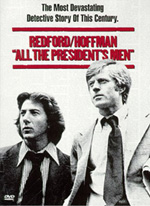
I do think that the film ALL THE PRESIDENT’S MEN inspired many young people to go into journalism. It presents a myth -- two dogged, independent journalists who will keep going until they drop to prevent the government from concealing its corruption. But while no one doubts that Babe Ruth broke the home run record, there is some dispute as to whether or not Woodward & Bernstein brought down Richard Nixon.
What Woodward & Bernstein actually did was keep the story alive until it drew the interest of serious people in government intent of pushing the official investigation -- people like Judge John Sirica and Senator Sam Ervin. They really drove what eventually happened to Nixon.
The final scenes of the film, however, seem to imply that “Woodstein” single handedly brought down the President. Well, they did play a part, but they had help from of a lot of courageous whistle-blowers inside the government. It was a joint venture between two reporters, some gutsy civil servants, and Sirica and the Senators.
Rich Miller
From the point of view of the film, I thought the climax was when [WASHINGTON POST editor] Ben Bradley decided to stand behind his troops and print the story despite threats from the White House.
Chris Hanson
Absolutely. I show this film to my classes, and every time I see it I still get goose bumps when Jason Robards (as Bradley) gives his final speech, even though I know that what the real Ben Bradley would have said to them was probably: “Don’t fuck up again.” No speech.
While I can’t say that ALL THE PRESIDENT’S MEN
was the main cause of my going into journalism, I was very taken with the film when I saw it, and also with the book (published prior to the film). And
ALL THE PRESIDENT’S MEN definitely led to other films with the same message like THE
CHINA SYNDROME and THE INSIDER.
In THE INSIDER, the reporter has to go around his own corporation in order to get his story out. So it tells us something about what has happened to the news business since Watergate. A news organization is swallowed up by some company which has been swallowed up by another company. Before you know it, the news division is just part of a conglomerate, and the news values get lost.
Rich Miller
Chris, you teach journalistic ethics: was that reporter “ethical” – going around his editors, going outside his organization?
Chris Hanson
There’s no easy answer. In THE INSIDER, the reporter has a conflict between compelling values. On the one hand, he has obligations to his colleagues and his organization. On the other hand, he has obligations to his source and to the story itself. So it’s a difficult decision. I admire what the real Lowell Bergman did, but his 60 MINUTES bosses at CBS did not.
Rich Miller
I used to be the UCH Director of Internal Audit. Internal auditors have a code of ethics, an absolute duty: You cannot sit on stuff. Is there a similar sort of journalistic duty to the public that says, “I am not allowed to sit on a story!”? If a reporter knows something that the public ought to know, but it’s being suppressed, does the reporter have a duty to the public?
Chris Hanson
Certainly. Of course, journalists sit on stories all the time. Sometimes they just do it to get maximum impact for the story. For example, you wait until Sunday so you will get more readers. Sometimes television news organizations will sit on stories in order to wait until sweeps. If the story involves public safety or something else the audience needs to know quickly, delaying very long can be pretty despicable, unless more reporting needs to be done.
I also liked THE INSIDER
as a drama because it deals with the way journalists sometimes have to push potential whistle-blowers in order to get information.
Rich Miller
Let’s talk about sources in the context of ABSENCE OF MALICE. When you’re a beat reporter, you have to use the same source over and over again, so you develop a relationship, right? But if you know that you’re only going to use the source once, then there is no relationship. What’s the difference between the way a journalist cultivates a news source and the way a police department develops an informant, or even more extreme, how the CIA recruits spies?
Chris Hanson
There are similarities and differences. If you are on a beat, you need to maintain relationships with your sources, and that can really constrain the reporting and make the reporter the tool of the police chief or whoever. But other problems surface if you only plan to deal with the source once. In
ABSENCE OF MALICE, the way the reporter treats one source (“Theresa”) is despicable.
One of the things that you need to do as a reporter is gage the level of naiveté and vulnerability of your source, and take that into account. If you don’t do that, if you don’t do something to help protect a vulnerable person from himself, you can end up doing pretty awful things. So you have to balance the importance of the information with alternative ways to disclose it (not revealing the person’s name or whatever). It’s messy.
ABSENCE OF MALICE shows an example of a reporter really blowing it.
Parallels to other professions? That’s a very complicated question. I once talked to this guy in British Intelligence, and he thought the jobs were very similar, despite all of the glamour attached to movie spies and so on. There’s a lot of drudgery to the routine, going back to sources over and over and piecing information together. But one thing that intelligence agencies tend to do far more than journalists is corrupt people and then blackmail them. First the agent gets a person to cooperate for some idealistic reason, next he induces him to take money. Then he’s got him by the balls.
Of course, there’s a little edging toward blackmail in
ALL THE PRESIDENT’S MEN. One married source doesn’t want anyone to know that he met a woman in her apartment. Woodward hints he might disclose this unless the source cooperates.
Jan Huttner
Drudgery! In ALL THE PRESIDENT’S MEN
Woodward & Bernstein have to go through boxes and boxes of cards at the Library of Congress. There are several comparable scenes in
VERONICA GUERIN.
Rich Miller
According to the film, Veronica Guerin began her career as a business reporter, so the film shows her doing a lot of ticking & tracing. It all looked very familiar!
Chris Hanson
Guerin certainly knew how to trace the money trail. A lot of investigative reporters have comparable skills. It’s similar to auditing in that you have to be very systematic. Rich, you have a CPA, but in journalism you don’t have to have any specific credentials. So you get some loose cannons, journalists who don’t really know what they’re doing.
From what I’ve read, the real Guerin was one of them. According to Emily O’Reilly’s book, she reported in the first person, & treated the news as a personal crusade with herself as the hero. Like
Geraldo. If that weren’t troubling enough, she let criminals manipulate her, believing and printing lies that evidently resulted in a mob bloodbath, as the film points out. Guerin was supremely talented and brave but she needed a strong editor with serious news values to guide her very carefully. However, it seems her paper wanted
sensationalism
Jan Huttner
Cate Blanchett certainly plays Guerin as a very pugnacious character! Anyway, this is a great segue to
SHATTERED GLASS, because Stephen Glass is clearly depicted as a reporter who thinks he can skip over the grunt work.
Chris Hanson
I was somewhat disappointed by SHATTERED GLASS, which let THE NEW REPUBLIC off the hook too
easily.
The other day I pulled out copies of TNR and just looked at a number of Stephen Glass’s real articles. They make preposterous claims about organizations that never existed. The quotations from sources are just too perfect. If it were satire it would be hilarious, but it’s not. How could the editors believe this stuff?
Jan Huttner
What were the clues, Chris? Given that Stephen Glass’s articles really were published in
TNR, how did he get away with it for so long? What is it about our culture that facilitates fabrication?
Chris Hanson
Part of it has to do with gaps in the magazine’s supposedly rigid but evidently porous fact-checking system. When reporters for the Forbes online magazine debunked Glass, they started with simple internet checks. That’s how they discovered that Glass was writing about organizations and people that didn’t exist. TNR editor Chuck Lane then easily saw through the fake web sites and voice males that Glass frantically created to protect himself. But why didn’t TNR catch it before?
Rich Miller
Vigorously fact-checking, doesn’t that depend on what kind of direction people get from their editors?
Chris Hanson
Exactly. It’s editorial policy. Editors should say to their reporters: “We’re not saying we don’t believe any of you. It’s just that every story will be fact-checked at a certain level before we print it.”
Jan Huttner
The reporters in SHATTERED GLASS
are all so young. Are the people in newsrooms typically that young?
Chris Hanson
No, but THE NEW REPUBLIC is known for that. The magazine doesn’t have a lot of money and it doesn’t pay very well, so it’s become a stepping stone for ambitious kids. They get really good assignments at a very young age and then they catapult from there.
Jan Huttner
Does it concern you that our culture loves “buzz” so much?
Chris Hanson
Yeah. Young kids come into a journalistic culture today in which reporters become famous for blabbing on television. Fame comes from who you know, and positioning, and so on. So the basic values of journalism have to be pounded in pretty hard. Otherwise, young people get sucked into all that…
Rich Miller
One example would be the Nicole Kidman character in TO DIE
FOR, right?
Chris Hanson
Yes. TO DIE FOR is the story of someone who is so desperate to be on TV that nothing else matters. There are several other films in which contempt for the press is also extreme. Films like DIE HARD and NATURAL BORN KILLERS reinforce the worst stereotypes about the press.
Many people hate the media, so filmmakers use media stereotypes to build villains. That’s fine up to a point but I think it’s probably damaging to the whole institution of the press. The media deserve criticism. There are a lot of very exploitive people out there. But the demonization goes too far.
Jan Huttner VERONICA GUERIN ought to put some weight on the other side of the table. As the film indicates, her death created public outrage in Ireland, and led to changes in several laws which made it easier for the police to curtail drug
trafficking.
Chris Hanson
Rich, speaking of life-and-death situations, did you encounter any Marine reporters who had been in Vietnam when you were in the
Marines?
Rich Miller
No, but one of my favorite movie characters is Private Joker in FULL METAL
JACKET. He’s a Marine journalist. In one scene they’re having a staff meeting, and his lieutenant says: “There are only two stories here in Vietnam. A Marine goes in single-handedly and kills lots of gooks, or a Marine gives half his salary to a person in distress. If you don’t have one of those two stories, I don’t want to hear about it.”
Chris Hanson
That’s interesting. I knew some people who had been Marine journalists in World War II -- these guys were really first rate reporters, but I have no idea what the deal was in Vietnam. To the extent the staff meeting scene was based on fact, that’s pretty pathetic. I doubt our troops want to read bullshit.
Jan Huttner
OK, guys. We’re segueing into military topics now… So maybe the three of us can talk more about combat movies in six months or so?
Chris Hanson
You bet.
FILMS FOR TWO® ADDENDUM:
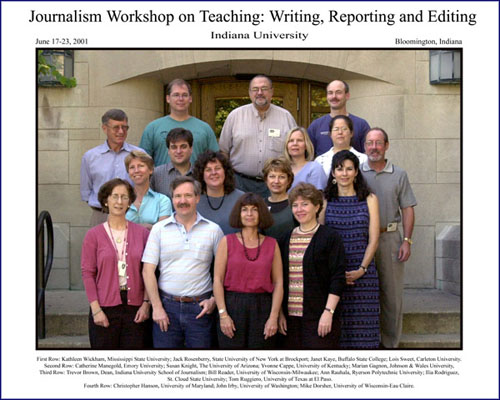
Chris Hanson at a recent journalism conference sponsored by Indiana
University.
(Chris appears in the turquoise tee-shirt in the top left corner.)
Christopher Hanson is an Assistant Professor at the Philip Merrill College of Journalism at the University of Maryland. Prior to receiving his Ph.D. in Mass Communication from the University of North Carolina, Chris spent 20 years as a print reporter. Among his numerous “routine” assignments, he’s been as close to home as the presidential races in 1988, 1992, and 1996, and as far a field as the civil war in Rwanda. He also served as a combat correspondent during the first Gulf War.
In addition to his Ph.D., Chris also received an M.A. from Wadham College at Oxford University, and a B.A. in History from Reed College in Portland, Oregon. In 1990, he was the Seattle Post-Intelligencer nominee for the Pulitzer Prize for his series on white collar corruption at Boeing.
Chris currently teaches courses in Journalism Ethics and Advanced Reporting: Beats and Investigation at U of Md. He’s a Contributing Editor for the COLUMBIA JOURNALISM REVIEW, and a regular contributor to various NATIONAL PUBLIC RADIO programs.
We first contacted Chris after hearing him interviewed on the NPR program ON THE MEDIA on a topic of great mutual interest: media coverage of women in the military. Since this feature barely scratches the surface of Chris’s expertise, we sincerely hope he will join us for another chat in the near future!